Italian Style Broccoli
Broccoli, native to the Mediterranean, is both delicious and nutritious when properly cooked. It contains more protein than most other vegetables and is easy to prepare. Eat it either raw or cooked. To cook – gentle steaming is healthiest.
Developed from wild cabbage, selective breeding during the Roman Empire produced Broccoli (Brassica oleracea var. italic). It then appeared in France at about 1560, and was introduced in England and America in the 1700s.
Broccoli contains phytonutrients that aid in disease prevention; its Vitamin K and Choline can promote improved brain function. Recent research has also shown that eating Broccoli can even boost metabolism by activating brown fat cells (that contain extra fat burning mitochondria).
Consuming Broccoli can help to:
- protect against some cancers
- fight against flu-causing viruses
- maintain: skin, eyesight, healthy immune system, brain function
- support: oral health, healthy bones and joints
- may slow/prevent: mental health decline, aging process, macular degeneration, neural tube defects.
To get the most health benefit from Broccoli choose stalks with tightly budded heads, crisp leaves and are deep green in color. Do not select portions that are limp/wilting or turning yellow.
Be sure to keep the Broccoli dry; store it for up to 3 days in the crisper drawer of the refrigerator. Raw broccoli is low in calories and almost 90% water, 7% carbs, 3% protein and contains Omega-3s. One (1) cup of raw broccoli, 91 grams contains:
- Calories: 31
- Protein: 2.5 grams
- Carbs: 6 grams
- Sugar: 1.5 grams
- Fiber: 2.4 grams
- Fat: 0.4 grams.
NOTE: Consuming broccoli may interfere with blood-thinning medications. Consult with your healthcare provider, if this is the case.
Here is a Broccoli side dish recipe that is easy to prepare. Even the broccoli hater in our house liked it!

Italian-Style Broccoli
Broccoli, Italian Style
Prep time: 15 minutes; Cook time: 25 minutes; Servings: 6
Ingredients
- 8 Cups Broccoli, florets
- 4 tsp. Garlic, chopped
- Olive Oil, extra virgin
- Sea Salt, to taste
- Ground Black Pepper, to taste
- 1 tsp Lemon Pepper
- 2 Tsp Lemon juice
- ½ Cup Parmesan cheese, grated
Directions
- Preheat oven to 425 oF.
- After washing, pat Broccoli dry as possible with paper towel for cooking purposes.
- Place Broccoli florets in a large bowl and toss with: 4 teaspoons of chopped garlic, 1 teaspoon of Lemon Pepper, ~ 1/3 Cup olive oil.
- Add salt and ground black pepper to taste.
- Place Broccoli/Garlic mixture on a flat baking pan; evenly disperse it across the pan.
- Roast it in the preheated oven (425oF) for ~ 15 minutes.
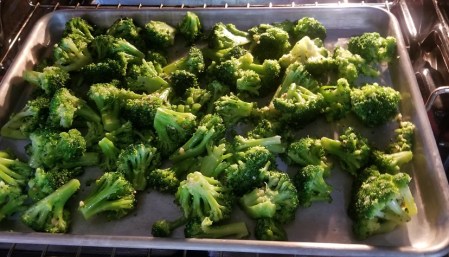
Sheet pan of broccoli, oven-ready
- Now, use a spatula to turn Broccoli over to ensure even roasting.
- Roast for another 10 minutes. The Broccoli florets will be crispy on the outside when done.
- Remove Broccoli from the oven and place in bowl.
- Toss the Broccoli with: 2 to 3 Tablespoons Olive Oil, and 2 Tablespoons Lemon juice.
- Sprinkle with ½ Cup Parmesan cheese. Serve.
 FIT CUI - A Fitness & Cuisine Program